
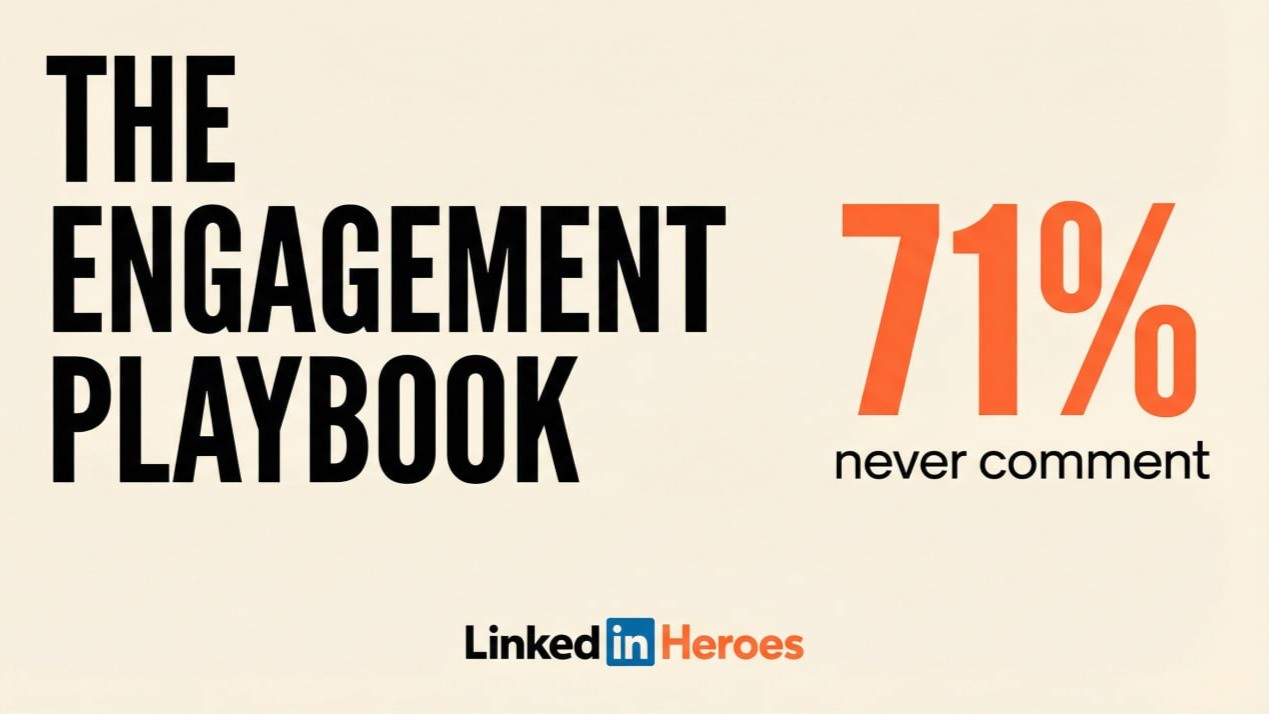
You published the post. Now what?
The real growth happens in what you do next — and most people do nothing.
Welcome back to LinkedIn Heroes! We decoded the algorithm. We fixed your profile. We built the content playbook. Now the hard question: why are your posts still getting crickets?
Here's the thing — great content with zero engagement strategy is like opening a restaurant with no sign on the door. The food might be perfect. Nobody walks in.
LinkedIn comments grew 37% year-over-year in early 2025. DM response rates are now double cold email. And there's a tactic getting 71% response rates that almost nobody uses.
Today — the engagement playbook. Comments, DMs, networking, and the recovery plan for when everything flatlines.
If You Only Have 60 Seconds
- Comments beat likes 3:1 for reach — but only if they're longer than 10 words
- Voice notes in DMs get 71% response rate — vs 24% for text. Almost nobody uses them.
- Engagement pods will kill your account — one creator went from 8,500 to 340 impressions overnight
- LinkedIn has a hidden "viewer tolerance" score — if people keep scrolling past you, you slowly become invisible
- Recovering a dead account takes 5 days of commenting — before you post anything
- The "Did my voice clip come through?" follow-up — gets 40% response rate
The Comment Game
You already know comments matter. But LinkedIn doesn't count comments. It evaluates them.
The algorithm uses NLP to assess depth — whether your comment introduces new keywords, asks a question, or sparks a thread.
"Great post!" and emoji reactions? Near-zero algorithmic weight.
"LinkedIn's algorithm now prioritizes reply rate over like count. Posts that generate conversations get 3x the reach of posts that collect passive engagement."
What the data shows:
- • Comments longer than 10 words get significantly more algorithmic weight
- • Posts where the author replies to comments see 2x+ distribution
- • Well-crafted comments on OTHER people's posts can receive 30-75x more likes than your own posts
- • Meaningful comments drive 8x more profile views than likes alone
What a good comment actually looks like:
Bad: "Great post! 🔥"
Zero algorithmic weight, zero relationship built
Bad: "Totally agree, this is so true!"
No new information, no question, no thread
Good: "The point about dwell time hit me — I tested this last month by adding 3 line breaks every 2 sentences. Impressions went from ~800 to 2,400 on two consecutive posts. One thing I'm still figuring out: does this work the same way for carousels?"
Adds personal data, references specific point, asks genuine question
The 15-minute warm-up:
Comment on other posts for 15 minutes BEFORE publishing your own. Then stay active replying for 15-30 minutes after posting.
Responding to comments within the first hour yields +35% visibility.
The DM Playbook
Comments are public. DMs are where relationships — and deals — actually happen.
LinkedIn DMs vs cold email in 2025:
- • InMail leads: 18-25% response rate
- • LinkedIn DMs to 1st-degree: 16.9%
- • Average DMs: 10.3%
- • Cold email: 5.1%
LinkedIn DMs now perform 2x better than email outreach.
Voice notes — the data nobody believes until they try it:
- • 71% response rate for voice notes (vs 24% for text DMs)
- • 37% converted to booked meetings
- • Voice notes triple response rates from ~5% to 15%+
- • General benchmark: 30-40% boost over text
Why do they work? Nobody expects audio in their LinkedIn inbox. A 30-second voice note with your actual voice conveys more sincerity than any carefully crafted paragraph. You can't fake tone.
Pro tip: If no reply after 2 days, send "Did my voice clip come through okay?" — that follow-up line gets a 40% response rate. It's casual, non-pushy, and gives them an easy reason to reply.
Engagement Pods Are Dead
Not "fading." Not "less effective." Dead.
LinkedIn's AI now tracks comment velocity, account relationships, engagement timing, and semantic content. 15 people commenting within 90 seconds? Flagged. Same accounts liking every post at the same time? Detected.
The consequences are silent. One marketing director saw her average reach drop from 8,500 impressions to 340 overnight. No warning. No email. LinkedIn just stopped showing her content.
What works instead — build a real peer group:
Pod:
30 strangers liking every post at 9:01 AM. Same people, same timing, no real engagement. LinkedIn's AI catches this in days.
Peer group:
5-8 people in adjacent fields who actually read each other's work. You comment because you have something to say, not because it's "your turn."
When Nothing Works
Your posts are getting zero views. You're doing everything "right." What's going on?
LinkedIn has a hidden "viewer tolerance" score.
When users consistently scroll past your content without engaging, the algorithm remembers. And progressively stops showing them your posts.
Why posts die — the real reasons:
- External links in post body — roughly 60% reach reduction
- No early engagement — if nothing happens in the first 30 minutes, distribution contracts
- Inactive audience — many of your followers are dormant
- Engagement bait — "Agree? Comment below!" is now actively suppressed
- Mismatched content/audience — motivational fluff for a technical audience won't distribute
- Same topics, same angles — the algorithm notices repetition
How to Recover
This framework helped one creator go from 1K to 100K+ impressions in 7 days:
1. Don't post yet. ENGAGE first.
20-30 comments/day for 5 days. Not drive-by likes — actual comments. Show the algorithm you're alive and contributing.
2. Then post 3-5 times weekly.
Mix it up: Monday — personal story. Wednesday — tactical how-to. Friday — observation or contrarian take.
3. Own your first 30 minutes.
Reply to every comment within minutes. Leave 3-5 bonus comments on your own post to create thread depth.
4. Send 3-5 intentional DMs per day.
Not to sell — to reconnect. Genuine check-ins. The algorithm tracks DM activity as a trust signal.
5. Stick with it for the full cycle.
Days 1-5 feel pointless. Week 2 you'll see small bumps. Week 3-4 distribution starts widening.
Timeline: If you have existing credibility, results come within a week. Starting from scratch — 30-60 days. Recovering from pods specifically? 6-8 weeks.
Your Numbers — What's Good, What's Not
Engagement rate by follower count:
- • 1K-5K followers: 4-8% engagement
- • 5K-10K followers: 3-5%
- • 10K-50K followers: 2-4%
- • 50K+ followers: 1-3%
Smaller audiences often mean more engaged audiences. That's an advantage.
The metric nobody tracks but should:
Comments have a 0.95 correlation with marketing qualified leads in B2B campaigns. Not impressions. Not likes. Comments. If you're in B2B and not tracking comment-to-lead conversion, you're measuring the wrong things.
The Uncomfortable Truth
Publishing a post is the easy part. The real work is everything around it.
Most people post and wait. The ones who grow are the ones who show up in other people's comment sections, who send DMs that aren't pitches, who build relationships before they need them.
The algorithm isn't hiding your content. It's measuring whether you actually participate.
You can't shout into a room, walk out, and expect people to follow you.
What's Next
Next issue: Personal Branding on LinkedIn — how to become the person everyone remembers in your niche. Not through tricks, but through positioning that makes you impossible to ignore.
Until then — stop broadcasting. Start engaging.
— LinkedIn Heroes Team
P.S. Found this valuable? Share it with someone who's struggling to get engagement on LinkedIn. The best way to grow is to help others grow with you.